
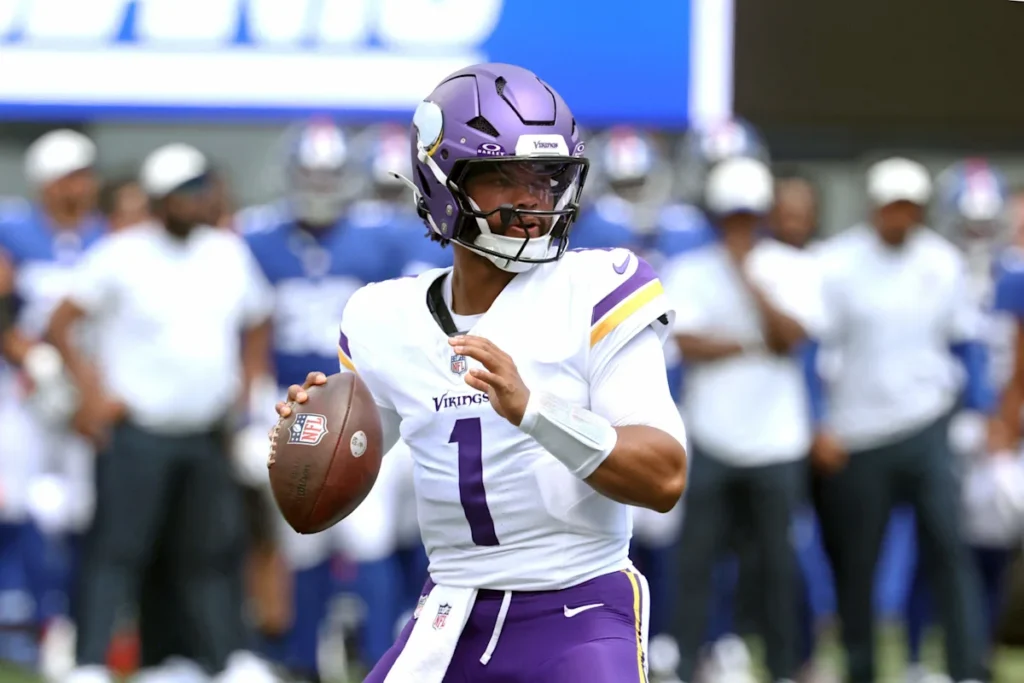
Heading into the 2026 season, the Vikings have once again turned to a veteran quarterback down on his luck. This time it is Kyler Murray hoping to revive his ailing career and offer some salvation for fantasy football managers.
After unceremoniously being paid by the Cardinals to leave, Murray signed a veteran-minimum contract with the Vikings and has been named the Week One starter. Murray, whose Call of Duty exploits have surpassed his on-field play in recent years, stated: “I’m not too focused on the long-term vision of it. I’m really just focused on the process of it, and that’s day-to-day.”
The reality is that Murray is playing for his NFL career. Luckily, he is playing under a coach who has saved careers – most recently Sam Darnold. But Murray is a different type of quarterback from previous Kevin O’Connell success stories. Murray has a career scramble rate of almost 7% – compared to Sam Darnold’s 4% rate in Minnesota and Kirk Cousins’ 1.5% rate in Minnesota. The rushing upside is a major part of the Murray appeal. Combine that with the fact that the Vikings have run just 48% of their plays from shotgun over the last five seasons, compared with 72% in Arizona. This does suggest that Minnesota may have to adapt for Murray. Or vice versa.
Still, Murray represents a low-risk gamble for a team that is built to win now – that is the same perspective fantasy football managers should adopt in drafts. When Murray has played in a minimum of 10 games (five seasons), he has averaged close to 20 FPTs/game – his career high was 23.7 PPG in 2020. Murray is priced as the QB19.
That’s cheap for a quarterback with such a high rushing upside and the second-easiest strength of schedule for the position. If you want to draft Murray, draft another late-round quarterback as a safety net due to his recent injury history – Murray has missed 21 games in the last three seasons.
Health concerns aren’t limited to the quarterback position. Injuries impacted the Vikings’ offensive line in 2025 – they ranked 18th overall according to PFF. Minnesota used 26 starting five combinations, which was second only to the Chargers (29). The Cardinals’ offensive line ranked 20th overall last season – though the Minnesota line is projected to improve, health permitting. In seasons when Murray has had a top-10 offensive line (2020 and 2021), he finished as QB3 and QB10.

A healthy line will benefit the run game. With Murray, the Cardinals’ run game produced two top-12 RB finishes – James Conner finished as the RB5 in 2021 and RB11 in 2024, with the lead back averaging 39 receptions per year. In Minnesota, neither Jordan Mason nor Aaron Jones was able to gain control of the backfield last season, finishing as the RB36 and RB41, respectively. Mason is set to take the early down work, but he won’t be a consistent feature in the passing game (28 career receptions). If I’m drafting one, it is Mason, who led the Vikings in high-value touches last season.
The run game can only do so much. The Vikings offense desperately needs to get the passing game going to repay Justin Jefferson’s eye-watering ADP of WR6. Over the five seasons when Murray has played at least 10 games, his WR1 has averaged 14.3 PPG, which would represent another disappointing season for Jefferson. DeAndre Hopkins averaged 18 PPG in the 2020 season (WR4) – this was the peak fantasy production for any wide receiver with Murray as the QB. Outside of that season, Murray has only ever supported two 1,000+ receiving-yard seasons (DeAndre Hopkins in 2020 and Trey McBride in 2024). Further, Murray has only ever delivered one WR1 season and one WR2 season – that was DeAndre Hopkins in 2020. Gulp.
As good as Hopkins was, Justin Jefferson is in a different league – and Murray has never had a playcaller with the credentials of Kevin O’Connell. Helped by the Vikings’ league-easiest wide receiver schedule, Jefferson should bounce back – though I’m unconvinced he can repay his current ADP. In 2025, Jefferson had just 84 receptions, 1,048 yards, two touchdowns, and finished WR32 – all career lows. JJ spent most weeks upset on the sideline and was unplayable towards the end of the fantasy season – he was the WR64 (yes, that says sixty-four) from Weeks 12-17. Obviously, you can’t bench Jefferson. So you start him every week. Hoping. Praying the situation will improve. It doesn’t. Now you’re in the Toilet Bowl.
If last season’s tendency towards 11 personnel continues (64.8% usage), Justin Jefferson, Jauan Jennings, Jordan Addison and T.J. Hockenson will likely be featured most frequently. Famously, Murray guided Trey McBride to a TE2 season in 2024 with the tight end scoring just two touchdowns. Although the Vikings have the projected 3rd easiest fantasy schedule for tight ends, Hockenson doesn’t feel like much more than an ancillary piece at this stage in his career. Jauan Jennings is also unlikely to replicate the red zone role he had in San Francisco. Jordan Addison looks like value at WR44. Addison finished as WR23 and WR21 in his first two seasons, making him an intriguing late-round bet.
There’s a lot of expectation on Murray to save this offense from the J.J. McCarthy/Max Brosmer reign of terror. But question marks around Murray’s health and inconsistent play still plague a Vikings team that desperately needs to get back on track – for the sake of Justin Jefferson managers everywhere.
Hey, you made it to the end! Good job by you. Thanks for taking the time to read my article – you can hit me up on X to talk ball any time @StartSitEmFF.

