
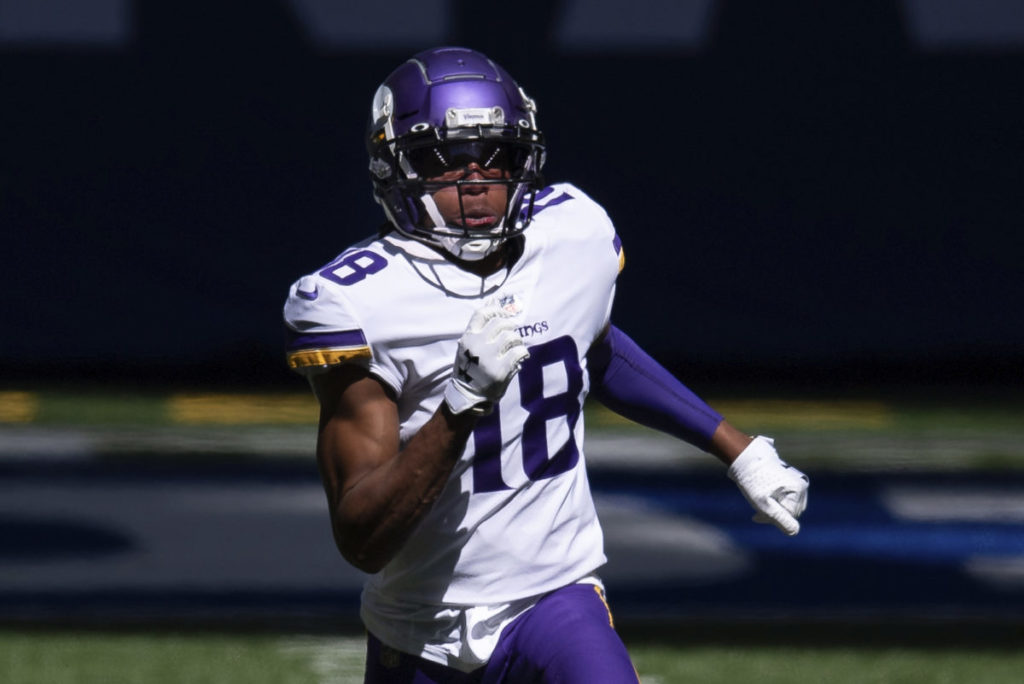
Our hearts dropped this week as Vikings’ star Wide Receiver Justin Jefferson went down hard onto his left shoulder. Jefferson then left practice and was seen holding his wrist to support his shoulder. A classic sign of clavicle or collarbone injury.
Thankfully, we didn’t have to speculate long as only a few hours later, Adam Schefter reported that Jefferson “has a sprained AC Joint” and it was considered “nothing serious, per source, but there would be further testing this weekend.”
So right away, that tells us that Jefferson had an immediate radiograph or x-ray and it was determined that he did not fracture his collarbone which would have knocked him out for 6-8 weeks.
It also confirms that Jefferson didn’t dislocate his shoulder which could have left him with an associated labral tear. This injury could have also taken 6-8 weeks to return from and significantly increased his risk for re-injury in the future.
All of this is good news because it leaves him with the best case scenario both in the short-term and long-term for an AC joint sprain.
AC Joint Sprains
An AC or acromioclavicular joint is where your clavicle or collarbone meets your scapula or shoulder blade. This collarbone is attached to the shoulder blade by four ligaments as shown below. However, the specific ligament we are most interested in is the acromioclavicular ligament which attaches the collarbone to the acromion of the shoulder blade or the top part of the shoulder socket. However, we need to be aware of the other ligaments as based on the severity of the injury, these too can be affected.
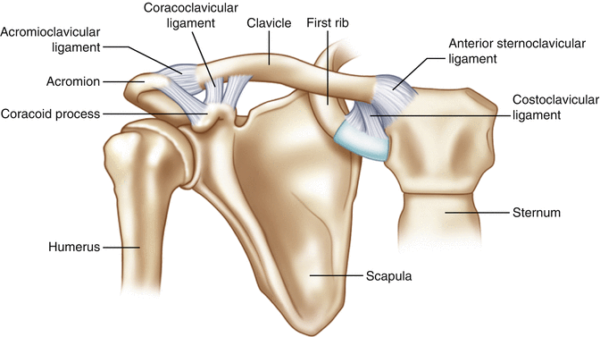
With AC sprains, there are six possible types that the injury can be classified as. Compared to the ligaments of the knee such as the ACL and MCL that only have three. The AC joint can be irritated/stretched, partially torn, or completely torn. In severe cases, the coracoclavicular ligament can be detached as well as the muscles surrounding the joint such as the trapezius and deltoid muscles which would require surgery.
However, given what we have heard out of Vikings’ camp, I believe it is safe to assume that only a grade 1 or grade 2 injury occurred.
So what does this mean for Justin Jefferson this season?
You can breathe a sigh of relief because even in the worst-case scenario this is a Type 2 sprain, Jefferson would likely only be out 4-6 weeks at the most. The Vikings’ first game is September 12th, which would put Jefferson at just over five weeks of recovery.
If it’s Type 1, which I strongly feel it is given the initial reports, he would likely be out just 1-3 weeks before returning to team activities. Many athletes can return from type 1 sprains very quickly but given wide receivers require more overhead motion and the timetable until the start of the season I see the Vikings taking the conservative approach in this situation.
Both injuries will likely result in seeing Jefferson in a sling for a short time to help let the joint heal. So don’t overreact, this is part of the healing process even for the lowest type of injury.
Update: As of 10 pm ET on August 5th, Ian Rapoport reported that Jefferson’s testing all came back positive and he is now considered day-to-day. This all but confirms it was just a mild type 1 sprain as expected.
Fantasy Impact
Unless we see it come out with further testing this weekend that Jefferson has any grade over a two, he does not need any adjusting in your rankings. Jefferson should be just fine this season with little risk of re-injury. It’s possible Jefferson has some slight hesitation to start the year taking contact or fully extending his arms but given the low severity, I feel this risk is minimal.
As for dynasty, a shoulder sprain or separation is a much different injury than a shoulder dislocation. A dislocation has much more risk for frequent dislocation as with Dalvin Cook. A separation has little risk for future separation. Some studies report some minor pain with long-term outcomes of shoulder separation, but this shouldn’t become a lingering injury or an injury that needs to be approached with caution.
I’m drafting Jefferson with full confidence this season and cheering for a small post-injury discount. I also would be buying any shares of him in dynasty if any owners are leary over this injury.
Don’t forget that Jefferson broke records in receiving yards as a rookie and was sixth amongst WR in 0.5 point PPR, all while barely playing until Week 3 and scoring a modest seven touchdowns while his 31-year-old running mate Adam Thielen scored 14.
People like to believe that the Vikings threw excessively more pass attempts last year which led to this production but the 2020 Vikings team had the sixth-lowest passing rate in the NFL and Cousins threw the second-fewest pass attempts of his six seasons as a starter.
There is room for growth as Jefferson comes into his second year, don’t let this injury scare you away from him.
-Zach Pavlichek, PT, DPT
As always, follow me on Twitter @Zachpav42 and hit me up for any injury concerns or advice!

