
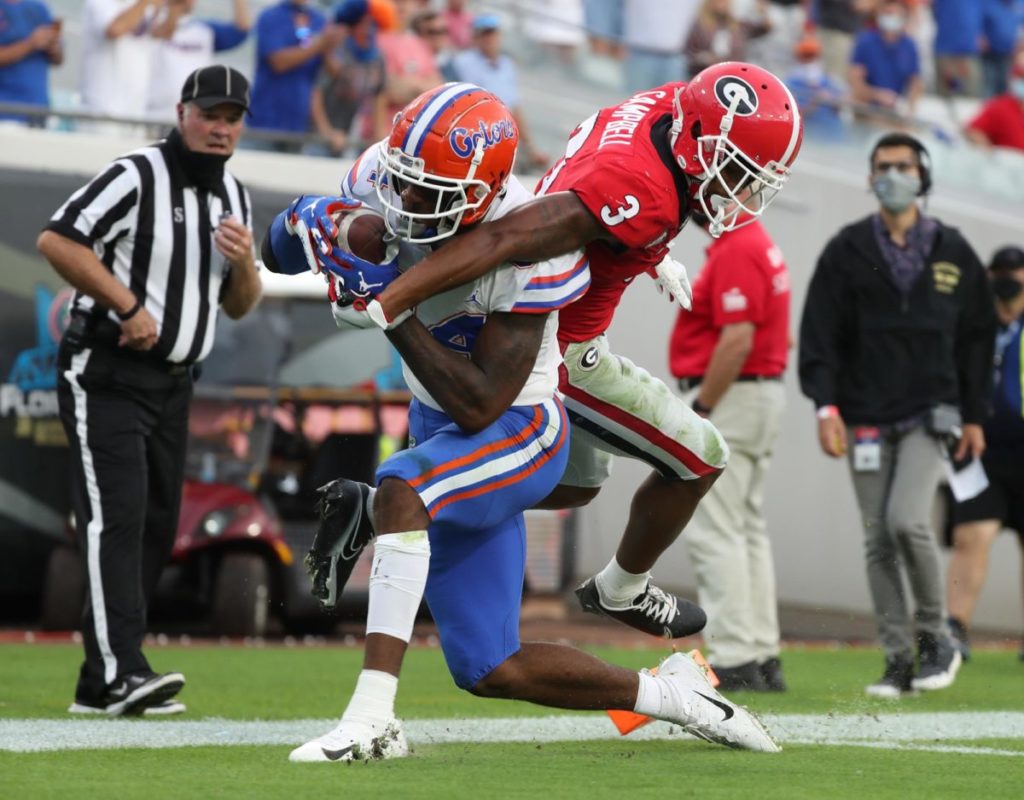
I get it. Kyle Pitts is the savior that’s going to rescue your fantasy team from the desolate tight end landscape. Based on the eye-test and a lot of metrics, that seems to be true. HOWEVER, if Kyle Pitts is truly an NFL-level tight end, he would have to absolutely smash all rookie records in order to meet some of the expectations being laid out by the fantasy community.
The Best Rookie Tight Ends
In the last 20 years, there have only been a handful of standout rookie tight ends: Evan Engram, Rob Gronkowski, and Jeremy Shockey. Something can be said for John Carlson and Hunter Henry, but they didn’t finish high enough at the position overall to be considered here.
| Name | Targets | Receptions | Yards | Touchdowns |
| Evan Engram | 115 | 64 | 722 | 6 |
| Rob Gronkowski | 59 | 42 | 546 | 10 |
| Jeremy Shockey | 128 | 74 | 894 | 2 |
Engram was the most balanced of these three, but he’s been unable to hit any of these marks again in his career. A lot of this can be chalked up to injury, as 2020 saw him appear in all 16 games for the first time. However, if we’re going to attribute injuries to Engram’s lack of production, we should also look at how injuries provided opportunity. In 2017 Sterling Shepard missed five games, Odell Beckham Jr. missed 12 games, and Brandon Marshall missed 11 games. Combine that with a lack of production at the running back position, and New York provided great circumstances for an early breakout season.
Immediately Gronk’s outlier season becomes apparent. He caught double-digit touchdowns, something he’s done four more times throughout his career. We’re also dealing with a guy that was named as one of the best 100 players to ever play in the NFL. I don’t think it’s fair to compare Kyle Pitts, who hasn’t even stepped on an NFL field, to Gronk just yet.
Like Engram, Shockey also posted career highs during his rookie year. While he had years that came close in targets, receptions, and yards, he was never ever able to surpass his rookie totals. Of the three, Shockey was drafted with the highest capital at pick 14, and some experts have Pitts going even higher in their mocks.
Rookie Tight Ends Historically
Typically it takes time for tight ends to develop in the NFL. A lot of that has to do with blocking ability and how different college programs utilize their tight end position. Tight ends that fit more of a blocking mold typically tend to be a little more NFL ready while guys that are basically large wide receivers can take more time. Looking at the unquestioned, top two tight ends and an NFL newcomer might help clear this up.
Travis Kelce wasn’t even targeted in his rookie season. He finally broke the 100-target mark in year three and didn’t surpass the 1,000-yard mark until year four. Despite being the TE1 in fantasy for the last five seasons, he’s only hit double-digit touchdowns twice.
George Kittle had a breakout in year two, but like Engram’s breakout rookie year, the way was paved with key injuries. Kittle had more than twice as many receptions as Kendrick Bourne, the next best receiver for the 49ers in 2018. Nevertheless, all of this happened after a pedestrian performance that landed him as the TE19 in his rookie season.
This brings us to a guy that recently went with high draft capital, T.J. Hockenson. Hock finished as the TE5 this past season, but because of injuries, hardly made it into the top 32 at the position his rookie season. He finished as TE31, but the low finish shouldn’t solely be chalked up to injury. He was TE23 in terms of average points per game (for players that appeared in at least 10 games).
But What About Kyle Pitts?
Pitts is impressive, to say the least. He went had 43 receptions for 770 yards and 12 touchdowns in only eight games this season. Those are better numbers than Hockenson put up in five more games at Iowa his final season. Pitts is awesome at high-pointing the ball and making contested catches. On top of all of that, he’s just really fun to watch.
Look, I’m not going to tell you that Kyle Pitts won’t be a special player in the NFL. All signs point to that being the case. What I’m saying is that if you’re drafting Kyle Pitts in the first round of rookie drafts, you need to be prepared to ride the storm out should he not have a record-breaking rookie season. You can’t abandon the ship and trade him away, or even worse drop him, if he doesn’t produce immediately in the NFL. Remember, tight ends take time.
I’ve seen arguments that Pitts will outperform all of the rookie WRs in this incredibly deep class. That won’t happen. Only two TEs would’ve finished in the top 36 at the WR position this past season, Travis Kelce and Darren Waller. To say that Pitts is going to reach that level in year one is unrealistic.
Assuming Pitts lands on a team with a hole at the position that is willing to spend high draft capital on him, he should be well worth a first-round rookie pick. He’ll likely have an immediate role as a rookie, but I don’t think he’ll be fully unleashed until year two or beyond.
All of this is, of course, under the assumption that Kyle Pitts is going to get drafted and used as a tight end in the NFL. If a team drafts him and immediately converts him to wide receiver, obviously all bets are off.
Thanks for reading! If you want to hate on my Kyle Pitts takes or hit me up for fantasy football advice, follow me on Twitter @fantasyonefive.

