
Looking back and reviewing hits and misses each year is a task I encourage every analyst to perform. Not only is it part of holding yourself accountable, but it’s an opportunity to reflect and improve your fantasy football chops. As a community, we aren’t great at admitting when we’re wrong but this gives us the chance to pat ourselves on the back for our victories while also learning from our mistakes. We can’t get them all right and most of the time fewer than we’d like but we can gain a lot from evaluating both.
Let’s dive in!
Hit
Being right about a fantasy take doesn’t make you a genius and this activity isn’t meant to stroke one’s ego. This exercise is meant to be helpful and introspective. It’s not necessarily that we get it right, but where we went right and reviewing some of the processes that got us there.
Aaron Rodgers (QB)
Aaron Rodgers proved the critics wrong after putting forth a comeback season for the ages while the dynasty and NFL community at large considered him all but finished. Rodgers completed a career-high 70.7% of his passes for 4,299 yards and a career-high 48 touchdowns with just five interceptions in 2020. This comes after finishing the prior two seasons with just 51 touchdowns combined. It was fairly clear why Rodgers’ value had dipped so severely after the 2019 season. In fact, according to DLF’s ADP Over Time tool, Rodgers positional ADP dipped from 5.4 in 2019 to 11.5 2020.
From my perspective at the time, there were clear signs Rodgers’ efficiency would improve from those few down years. For one, Rodgers dealt with a few nagging injuries that affected his play but the larger issue was the broken relationship between the star quarterback and former head coach Mike McCarthy. New Packers head coach Matt LaFleur instantly showed a willingness to compromise and work with Rodgers’ suggestions for the offense. LaFleur comes from the McVay coaching tree and his system is designed to elevate the quarterback which is a factor I was banking on. They specifically implemented more play-action passes to open up the offense and take pressure off Rodgers.
While reading the tea leaves is part of the process it’s not nearly as clear cut as the numbers and that’s truly what made this a hit. Rodgers’ value dipping so low made it easy to pick him up late or trade for him penny’s on the dollar while understanding he’s finished outside the top-five fantasy quarterbacks just two of the last five years. This move won me and plenty others some fantasy championships.
Lesson: take advantage of ADP/value dips on studs.
Tyler Higbee (TE)
Higbee holds a special place in my heart considering last year someone told me I was giving bad advice by beating down the crowd pumping him up as a possible top-five TE candidate. At the time he was receiving the “baby Gronk” moniker. For me, this all took off when I did the research myself. The findings indicated historically a top-five tight end needs at least 90+ targets to even get remotely close to that threshold and I couldn’t find a way that would occur with team projections and fantasy outlook. It didn’t make any sense and the argument didn’t hold any water. I still got pushback after publishing the findings in a Twitter thread.
Higbee would need to be a feature target in the Rams 2020 offense to even sniff top seven status let alone top five. Much of his production late in 2019 came when Todd Gurley and Gerald Everett missed time due to injury, inevitably increasing Higbee’s target share and production. The league instantly adjusted to him the following season and so did the Rams when they added weapons and their current stars recovered from injury. His overall ADP spiked to nearly a top 100 pick and that was something I just couldn’t get on board with, the “upside” everyone raved about didn’t appear to exist to me.
Higbee isn’t some outstanding athlete and doesn’t possess any elite traits to warrant the hype he was receiving. Most people took a few game sample-size and extrapolated it out. As if Gronk had been signed to the Rams and stepped in Higbee’s place. We all love a good hot take but the team situation and the data didn’t at all suggest high-end fantasy productivity was on the horizon.
Lesson: Sometimes it’s better to listen to the data more and hype less.
Miles Sanders (RB)
This was a hit…but not the kind Miles Sanders truthers will enjoy reading. My opinion of Miles Sanders during draft season in 2019 is quite similar to my stance on him now. He’s not a workhorse running back, three-down back, or a bellcow. Whatever your favorite term is he’s just not it. He’s a great athlete and talented football player. However those things don’t always translate to fantasy points. Even though he posted an impressive 1.67 yards per touch in 2020. Sometimes it’s not entirely the player’s fault and there’s certainly some of that in his case.
Miles Sanders is listed at 5’11” 211 lbs. He possesses elite pass-catching traits that vault fantasy relevance. It’s not just Sanders size that has held him back but also the Eagles coaching staff who insist on using a running back by committee style offense. Many thought this would change in 2020 and they would give Sanders the reigns but he saw just 164 rushing attempts, less than he received his rookie season.
The Eagles also used Boston Scott and other less talented back in his place giving off the impression they could produce as well as he could. While advocates would point to his effectiveness in the passing game and big plays he’s not at all efficient. In fact, according to Playerprofiler.com, he posted a negative (-12.2) EPA in 2020. Highlighting his inability to be an impact player or game-changer for his football team.
Sanders seemed to dodge a bullet once Doug Pederson was fired but the new regime drafted Kenny Gainwell and resigned Jordan Howard to the roster. If that doesn’t decrease your confidence in Sanders then I don’t know what will. The kicker last year for me was his ADP leading into the year. He was going as the 16th player overall according to DLF’s ADP. Not a single manager got the return on investment they were looking for. Sanders finished as the 23rd overall running back in 2020.
Lesson: Don’t ignore a coaching staff’s possible impact on fantasy success.
Miss
We can’t always get it right and we shouldn’t be ashamed to admit it. I was a bit short-sighted and living in the past with some of my pre-season takes. However, we are here to break down a few of them. The good news is: you stand to gain a lot from evaluating your failures. Here we go!
Le’Veon Bell (RB)
This is a few years in a row I’ve missed big on a running back, but for different reasons. First, it was Joe Mixon as a top-five running back in 2019. Then I put on the cape for Le’Veon Bell all last year leading up to the 2020 season. I truly thought he would be the feature back in New York. Despite the horrifying prospect of Adam Gase leading the charge. I leaned in on his volume increasing and efficiency as well. Mostly due to an improved offensive line and a full offseason under his belt.
His ADP was dropping significantly to the point in which Bell was a great value and on film. Even in 2019, he was impressive and still showed signs of elite burst and vision but that proved untrue. He couldn’t even find much playing time when he was dealt to the Kansas City Chiefs. Even though it was an optimal landing spot. Bell was producing just 1.13 yards per touch (39th) and a -13.4 EPA.
I ignored Bell’s character concerns and the impact his full-year absence from the league could have on his body and overall performance. Turned a blind eye to the awful coaching staff and saw what I wanted to see, a cheap running back option with huge upside. I couldn’t see the forest through the trees and was blinded by the talent and past performance behind a superb offensive line.
Lesson: Stop living in the past and seeing what isn’t there.
Stefon Diggs (WR)
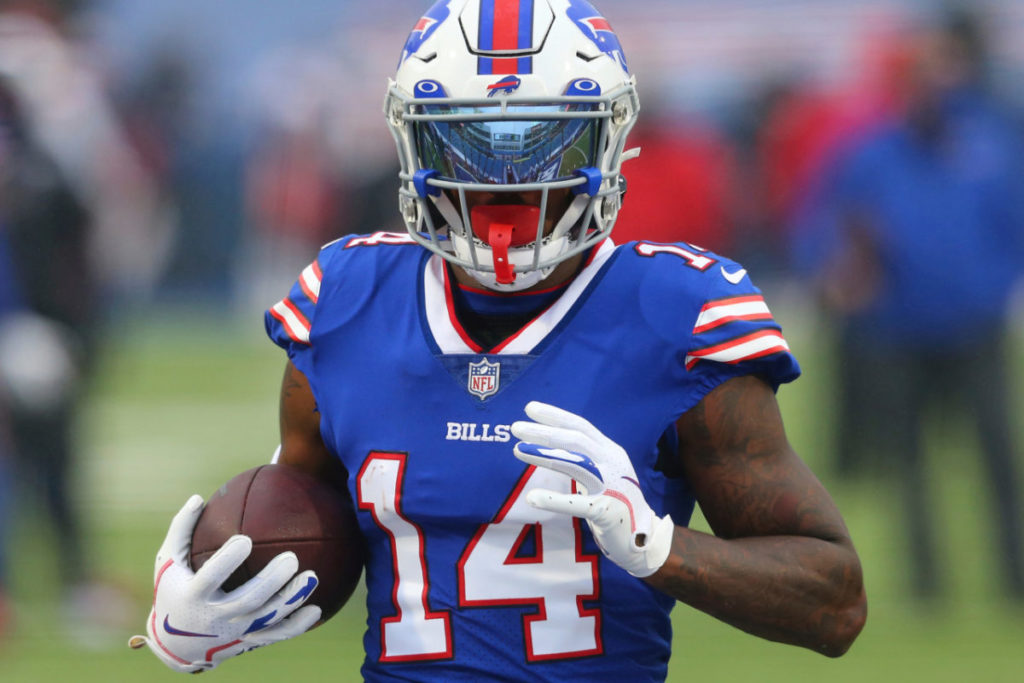
I missed the mark on Diggs. I had plenty of faith in his talent but I couldn’t get on the Josh Allen train. For all his improvements, I couldn’t get past Josh Allen’s consistent inaccuracy and carelessness with the football. It seemed to me he would always fall back into bad habits. Whether it was mental errors, ball security, or mechanics he would end up hurting his football team at key moments. Well, much of that changed in 2020. I was wrong, Josh Allen became much more accurate and efficient even given the mental errors.
While Josh Allen improved, Stefon Diggs benefited greatly. He became a target hog in a high-octane offense that featured him every moment they could. Diggs received a whopping 166 targets and caught 127 for 1,535 yards and 8 touchdowns.
Diggs was considered a WR1 since he was playing second fiddle to Adam Thielen but I couldn’t trust the talent in this case like I put my faith in Le’Veon Bell because of my bias against Josh Allen. Huge Mistake.
Lesson: Don’t let your bias control you.
Golden Tate (WR)
I feel pretty bad about this one. I touted Golden Tate all offseason as a late-round, high volume WR3/flex option with upside. Man was I wrong on so many levels.
One data point that kept me intrigued was his incredibly high target share before his stint with the Giants. He had finished five straight seasons with 100+ targets in Detroit. He entered a receiver-needy situation with New York at the time. I thought his reliability and ability to get open in the short areas would make him a premier target for Daniel Jones but not only did he get hurt and miss a ton of time but he just wasn’t the same guy at 31 years old.
I completely ignored his age and focused on the value of being able to get him for a lesser value than Sterling Shepherd or Darius Slayton at the time (which is clearly how it should’ve gone). To say he had upside was a bit gratuitous given the situation with a new quarterback and second-rate roster.
Lesson: The past doesn’t predict the future.
Thank you for reading. If you have any thoughts or would like to discuss, you can find me on Twitter @WillieBeamanDFF
For more Fantasy Football content, check out the rest of my work at DFF!

