
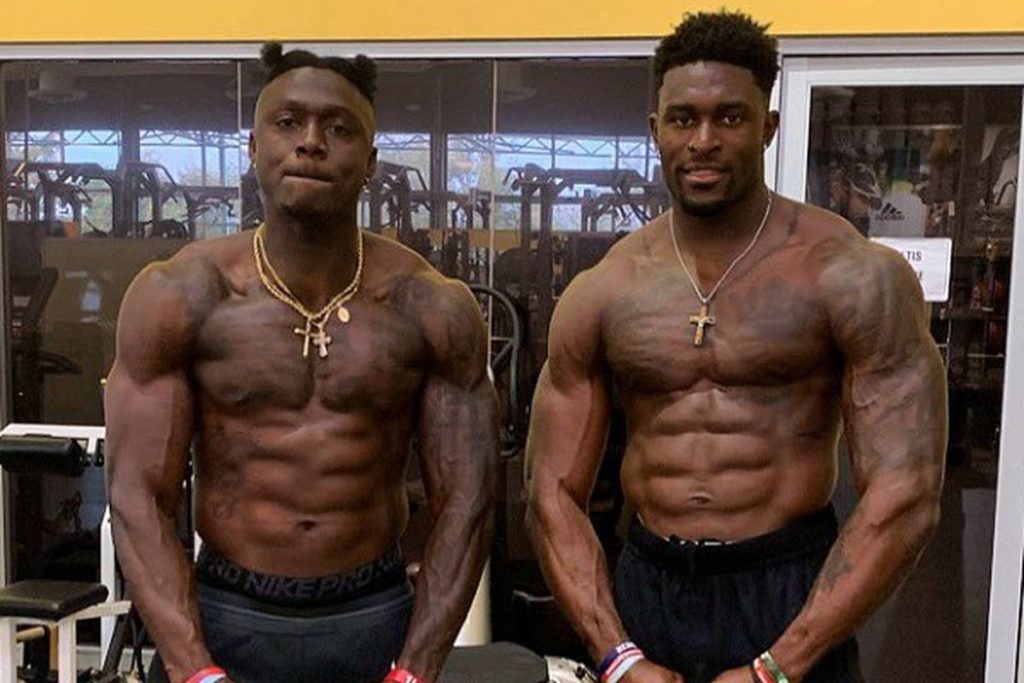
Believe it or not, Ole Miss is not known for producing great wide receiver talent. In fact, outside of Eli Manning and Evan Engram, they haven’t produced many fantasy-relevant players. After the 2019 NFL Draft, that changed. A.J. Brown and D.K. Metcalf were taken with the 51st and 64th picks, respectively. In year one, Brown finished as WR21, and Metcalf finished as WR33:impressive considering rookie wide receivers don’t usually break out until the back half of the season. The two both jumped up in the rankings and flipped positions in year two with Metcalf finishing as WR7 outpacing Brown who came in at WR12.
Both receivers find themselves as top ten dynasty assets entering the 2021 season. However, the fantasy community is divided on which player is better.
For a lot of managers, the two are deadlocked. So what else is there to do than make a case for each and let you, the reader, decide who you’d rather roster.
The Case for D.K.
College Production and Combine
Coming out of Ole Miss, D.K. Metcalf hadn’t posted great numbers.
| Year | Games | Receptions | Yards | Yards/Reception | Touchdowns |
| 2016 (FR) | 2 | 2 | 13 | 6.5 | 2 |
| 2017 (RSFR) | 12 | 39 | 646 | 16.6 | 7 |
| 2018 (SO) | 7 | 26 | 569 | 21.9 | 5 |
Although the work doesn’t jump off the page, when he played, Metcalf was a valuable asset to the Rebels. He dealt with injuries during his time in Oxford, most notably a cervical neck fracture that had one doctor saying he’d never play football again.
Many of the worries about D.K. Metcalf were immediately put to rest when he posted incredible workouts at the combine. Measuring in at 6’3”, 228 lbs., Metcalf ran a 4.33 40-yard dash giving him a speed score in the 99th percentile. If not for a horrendous showing in the three-cone drill, which many still mock to this day, he surely would have shot up draft boards. The lack of agility on display and the limited route tree in college had many questioning if he could even get in and out of breaks to run more complicated NFL routes.
Production Thus Far
In his rookie season, Metcalf saw 100 targets, bringing in 58 of them for 900 yards and seven touchdowns. He had a 20% target share on the team and caught a third of the passes thrown to receivers. The biggest takeaway from Metcalf’s rookie season is the 18 red zone targets he saw. This indicated the desire to use him as a weapon around the goal line and the possibility that he could realistically post double-digit touchdowns in years to come.
Last season D.K. boosted his efforts, taking 83 catches for 1,303 yards and ten touchdowns on 129 targets (16 red zone targets). While there was nothing noticeable in the way of splits in his rookie season, last season saw Metcalf producing much better in home games and wins. Now, this could be nothing more than a chicken-egg scenario where the Seahawks weren’t able to win because D.K. wasn’t scoring touchdowns, but it’s still worth taking note of. However, with Jalen Ramsey in the division, there may be cause to worry. Against the Rams, Metcalf was held to two for 28 and six for 59 in their two meetings last season, and he was only targeted four times when guarded by Ramsey.
Team Situation
Heading into next season, D.K. Metcalf finds himself a top dynasty asset being ranked higher than A.J. Brown in most places. The reasoning behind this is likely due to his quarterback and usage by the Seahawks.
Russell Wilson is viewed as a stable dynasty quarterback as he’s thrown for no less than 3,448 yards and 31 touchdowns over the last four seasons. He’s also supported a top-12 wide receiver three times with Doug Baldwin (WR10, WR8, & WR11) and came close twice with Tyler Lockett (WR16 & WR13). Last season Wilson supported a WR7 finish from Metcalf and a WR8 finish from Lockett. When the Seahawks “let Russ cook”, it is good for Metcalf’s fantasy value. However, with recent rumors of a disgruntled Russ, there may be trouble in paradise.
I’m guessing there isn’t much fire with this smoke, but it’s still something to be monitored for Metcalf’s long-term value.
The best part about rostering D.K. Metcalf is a boom/bust option that goes boom quite often. Metcalf was second in air yards, sixth in air yards share, and third in deep targets. What does all this mean? It means that when D.K. Metcalf catches passes they more likely than not are long plays and most long plays in the NFL result in touchdowns. Metcalf saw his targets increase this year, and he also caught a higher percentage of those targets. With trouble keeping the tight end healthy and Tyler Lockett fading in many games last year, D.K. became the de facto WR1 for the Seahawks. If this pattern continues and the Seahawks don’t find another receiving threat, Metcalf could soak up a ton of targets.
Fantasy Outlook
The issue is that, with the exit of OC Brian Schottenheimer and the hire of Shane Waldron, Pete Carroll has been very outspoken about what direction he wants the offense to take, stating, “We have to run the ball better, not even better, we have to run it more”. This is, and probably should be, alarming to anyone rostering a non-RB Seahawk. Carroll emphasizing that he doesn’t even care about the success of his run game, so long that the volume is there, is worrying. If Metcalf’s volume goes down, his efficiency will have to go up. With a player that relies heavily on deep targets, that’s a difficult thing to do. Of course, this could all be nothing because Pete Carroll has a reputation for coach speak, and this may be just that. He said a similar thing about wanting to “pound the rock” prior to the 2020 season and unleashing Russell Wilson.
If I’m rostering D.K. Metcalf, I don’t want him to be my WR1. He is too volatile and relies too much on deep targets that, while they came last season, may not always be there. While Metcalf could be a league winner with his boom games, he can also cost you a week if the Seahawks can’t (or decide not to) get him the ball. If Waldron unleashes the Seattle offense and can figure out a way to get Russell Wilson more time to throw, D.K. Metcalf’s stock goes through the roof as he has the athletic ability to be nearly unguardable.
The Case for A.J. Brown
College Production and Combine
A.J. Brown did not post as daunting of numbers in the combine, but his body of work in college showed what he could really do on the field.
| Year | Games | Receptions | Yards | Yards/Reception | Touchdowns |
| 2016 (FR) | 11 | 29 | 412 | 14.2 | 2 |
| 2017 (SO) | 11 | 75 | 1,252 | 16.7 | 11 |
| 2018 (JR) | 12 | 85 | 1,320 | 15.5 | 6 |
Putting up multiple 1,000-yard seasons in the SEC is no small feat. This may not be fair, but Julio Jones put up 179 catches for 2,653 yards and 15 touchdowns in his college career and Brown outpaced him in every category. This work obviously landed him on the Titans with higher draft capital, going 13 picks before Metcalf in the second round.
Production Thus Far
Seeing 16 fewer targets than D.K. in his rookie season, Brown was able to haul in 52 catches for 1,051 yards and eight touchdowns. On top of his receiving work, he took a 49-yard carry for a touchdown as well. A.J. didn’t see the same usage as D.K. though, averaging only a 68% snap share in his rookie season. Brown came on strong at the end of his rookie season posting finishes at WR6, WR1, WR8, WR14, and WR4 in the last six weeks of the season.
Entering this past season, Brown was hobbled and eventually missed Weeks 2 and 3 before coming back after the Week 4 bye. Despite all this, Brown finished the season strong only landing outside of the top 24 four times, one of which was still a top 36 performance. Brown caught 70 passes for 1,073 and 11 touchdowns on 106 targets. This past season Brown saw 26% of the Titans targets and 44% of their wide receiver targets. There doesn’t seem to be any discernible difference in home games and road games for Brown but does get less work in losses. Brown is already an extremely efficient receiver finishing tenth in yards, second in yards per routes run, second in average YAC above expectation, and second in fantasy points per routes run.
Team Situation
The perceived problem with A.J. Brown on the Titans is that the team is going to give a ton of work to Derrick Henry. It’s true. However, Brown’s success is more tied to the success of Henry than you’d think. In the past, the Titans have wanted to establish the run and feed Henry upwards of 20 carries a game. This opens up defenses to play-action. The scheme shouldn’t change much, as the offensive system will likely stay the same with an internal candidate, but it’ll be interesting to monitor as the Titans elevate Todd Downing to take over play-calling duties after the departure of Arthur Smith.
A.J. Brown finds himself as one of the only receiving threats left on the Titans heading into ‘21. Corey Davis and Jonnu Smith are free agents. The Titans will likely bring in another receiving option, but Brown has established himself as the clear alpha, so there is no real threat of him losing much volume.
Brown’s success with the Titans is tied to two players: Ryan Tannehill and Derrick Henry. Tannehill enters year two of a four-year contract. He’s looked great, and though it’s cherry-picking, it seems like a good time to revisit this comparison
After landing in Tennessee, Tannehill has had insane efficiency and has escaped the dark shadow cast by former coach Adam Gase. Henry is also entering year two of a four-year contract, but at 27 there are questions about his longevity. If Henry doesn’t last, the Titans could turn to a more pass-heavy attack meaning Brown’s volume would increase.
Fantasy Outlook
After returning from the Week 4 bye, A.J. Brown was WR4 through the end of the season. We found out after the season, albeit from a partially-anesthetized Brown, that he had clean up surgery on both his knees that may have hampered his ability on the field.
If I’m rostering A.J. Brown, I’m comfortable with him being my WR1. He has a decent floor and his production isn’t greatly dictated by game script. Outside of the beginning of his rookie season, he has consistently put up top 24 weekly finishes, and for that reason, he is safe to start week in and week out as your number one option.
Conclusions
Setting out to write this article, even though I rostered D.K. Metcalf, I found myself firmly in the A.J. Brown camp. Looking at the data, I’ve come back towards the middle a bit more. I think the deciding factor on which receiver is better for your fantasy team comes down to roster construction. If you’re able to pair D.K. Metcalf alongside somebody with a safer floor, then you can reap the benefits of those big games without the worry of him tanking your entire week if he doesn’t come through. With Brown, you’re able to take a big swing on someone that may be a little more volatile because he gets pretty consistent work and produces extremely efficiently.
If I had to choose one, it’s still A.J. Brown. However, in terms of a trade in fantasy, I wouldn’t add anything more than a third-round pick to D.K. to get Brown. Both have been extremely fun to watch, and they’ll both surely have continued success in the NFL.
Thanks for reading! If you have a strong opinion about DK or AJB, let me know on Twitter @fantasyonefive. If you’ve somehow found a way to get both Metcalf and Brown on your team, congratulations!

