

The Dynasty landscape is ever-changing and shifting depending on rule changes in the NFL, scheme changes around the league, position groups fading out, and then resurging through youth and the NFL Draft. I noticed a fairly drastic shift in the value of running backs while working through a few Dynasty and Devy startups this off-season.
RB Draft Strategy
Typically, I employ the “Hero RB” strategy for several reasons, including the fragility of the position and the ability to find later-round options to plug holes. However, I always felt it necessary to have that anchor. That feeling disappeared during the 2023 startup season, and I believe it’s due to a significant transition period in the running back position across the league.
Transition periods are critical to understand. You can find an entire video here on our YouTube channel, where I explain the concept in detail. That said, I opted for a “Zero RB” strategy this year, in which I waited until nearly double-digit rounds to select my first running back. Crazy, I know. But it worked out on multiple occasions, and I began to ask myself, should I prioritize running back over wide receiver, no matter what?
VORP
We’ve often been told running backs hold a significant advantage in terms of value over replacement and wins over replacement. Value over replacement player (VORP) measures how many more points a player scores compared to a waiver wire player. Wins over replacement player (WAR) is a similar measurement that uses wins instead of value (points). VORP allows us to compare players across positions and identify which players provide a significant advantage over the field. We can also establish the depth of value over replacement players by position. In other words, we can determine the scarcity of any point-scoring advantage by player and, more importantly, position.
I decided to collect VORP data for the past three years, divide it by the number of games played by each player to create VORP on a per-game basis and bucket the averages by the top 8, 12, and 13-36. The goal is to look at the middle rounds by position to get an idea of how significant an advantage we gain by prioritizing running backs over wide receivers, if at all.
Below is the average VORP variance from 2020-2022 split by running back and wide receiver, and then the difference between the position groups in the top 8, 12, and 13-36 range.
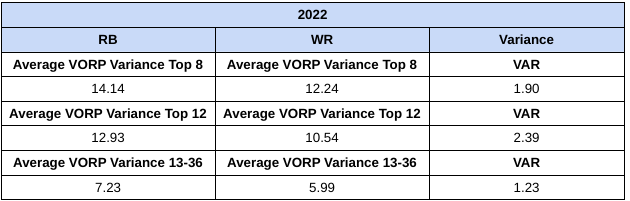

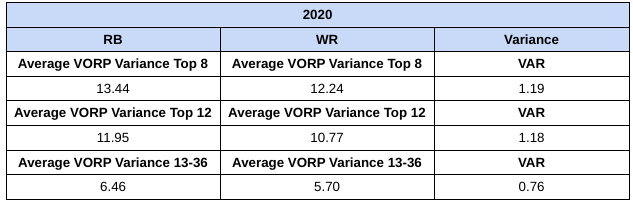
As we can see, the running backs, on average, edge out the wide receivers in value over replacement players in all buckets, but remember, the goal is to determine if we’re gaining a significant advantage in the middle rounds when prioritizing running backs.
Over the last three seasons, middle-round running backs have offered just .80 more points over replacement than wide receivers. The difference here is negligible, in my opinion. Therefore I don’t think there’s a good argument for blindly drafting running backs over wide receivers in terms of value (points/wins) added to your fantasy team, especially in the middle-late rounds.
The advantage, if any, can be found within the top 12, where running backs typically offer greater than 1.5 points over replacement player advantage compared to wide receivers. We should prioritize the top-5 and top-12 running backs over the top-5 and top-12 wide receivers, but the position groups have slowly grown nearer as the league places more and more focus on the passing game.

Defending the pass has become more challenging in recent years by the NFL implementing rules less tolerant of pass interference and physicality before and after the catch. These factors, among others, have contributed to an increase in pass attempts and yardage and altered how offensive and defensive coordinators construct game plans. In 2021 we witnessed the wide receiver outscore the running backs in the top-8 and the top-12 (we can thank Cooper Kupp).
The numbers fell back to earth in 2022 for wide receivers (potentially due to significant injuries and situational circumstances to top producers at the position), and to be clear, while it’s worth keeping in mind how quickly the advantage drops off, the Top 12 running backs should often be prioritized over wide receivers. Logically this makes sense from a football perspective too. The league has slowly abandoned workhouse running backs, by and large, but the ones who still qualify are typically the best of the best; the running backs who can handle a full workload and add value in the passing game. Running backs have the unique potential to become dual-threat players, while even the best wide receivers play a more limited role in comparison.
I’d like to reiterate that this research and theory ignores the impact of dynasty value, which in many cases, would outweigh the point value added to your fantasy team (depending on your team build, of course). This is simply meant to look at value over replacement player by position to determine if prioritizing running backs over wide receivers in the middle-rounds offers a significant weekly advantage using the last three seasons’ data.
Dynasty value is much more complex, and I have discussed these concepts in previous articles and videos.
At the very least, analyzing the VORP data helps contextualize our draft decisions and how players typically score points on average compared to their position group and how each group compares to each other.
I didn’t intend to delve any further down the VORP rabbit hole once I answered my initial question and theory. But an unexpected and enjoyable interaction pushed me further into the VORP void.
QB Draft Strategy
I was honored to be invited to The Superflex Supershow with John Hogue a few weeks ago after collecting the WR/RB VORP data. This topic arose as we discussed how to navigate the current dynasty landscape. I noted on the episode I had also been fading the QB3 position altogether (in Superflex leagues) because I didn’t see a significant advantage in rostering one, at least anecdotally at the time.
I was again asking myself a question: Does your QB3 matter? I found that if your QB2 went down, the QB3 often didn’t fill the role in terms of production, and the QB3 options don’t carry a ton of dynasty value as there is significant yearly turnover in the bottom third of the league at the quarterback position.
So, I pulled the same VORP data for QBs and compared them to the average VORP of RBs and WRs combined (all on a per-game basis). I shared the findings on an episode of Dynasty Underdog. I also shared it with John Hogue and Peter Howard to bounce the idea off him, ensure I don’t sound like a bumbling idiot, and potentially further the research by letting others ponder the theory.
With that said, let’s take a look at the QB vs RB/WR VORP buckets for 2022:

Notice how RB and WR, on average, offer greater value over replacement in all buckets, but most importantly, in the 13-36 bucket where the middle-round players and QB3s reside. There was just a 0.38 average variance between the quarterbacks in the 13-36 range, while there was an average variance of 6.61 in the 13-36 range for RB and WR. From a production standpoint, your QB3 was providing you 6 points less value over replacement on average than a potential replacement running back or wide receiver.
VORP data is just one way to test my theory, but after our conversation, Peter Howard took the idea a step further and looked at the top-36 finishes on average by position since 2000. Consistency and floor are overrated concepts in fantasy. The floor is typically irrelevant and doesn’t provide an advantage. Most fantasy matchups are won by significant margins week-to-week, so we should mainly be concerned with the upside. We want as many top 36 finishes as possible from each selected player. The players selected at the top of your drafts will provide plenty of top-36 finishes. They are first and second-round picks for a reason and offer an advantage over the field per the numbers previously discussed.
Peter’s chart and data shown below indicates since 2000, WRs outside the top-12 finish inside the top-36 more often than QBs outside of the top-12 (even RBs, though to a lesser extent). Peter was gracious enough to let me use his data, and everyone should follow him and check out his Patreon and other free content.

Whether you choose to select a QB3 is certainly more nuanced than productivity, top-36 finishes, and value over replacement player data. I know what you’re thinking, ”he is completely ignoring dynasty value and what rostering those backend quarterbacks have to offer in terms of trade value”. You’re absolutely right, but this research is intended to challenge the ideas that running backs always offer greater value over replacement and that you must prioritize a QB3, no matter what. The data would suggest otherwise.
Running backs aren’t offering as significant an advantage as they once were, and your QB3 typically isn’t providing an advantage on bye weeks or in case of injury. There is a real case for prioritizing a third (and potentially fourth) quarterback from the top-12 range, but that’s much easier said than done while building a competitive roster from top to bottom.
However you choose to use this information, the framework grants us a more granular outlook of how players score points compared to their counterparts and other positions. It allows us to recognize the actual advantages, if they exist, by breaking down raw points into value over replacement and percent of top-36 finishes. By doing so, we can more easily compare the players and positions and gain better insight to apply to future decisions.
If you read this and think of another way to test how much of an advantage we receive by drafting running backs over wide receivers in the middle rounds or if your QB3 actually matters, hit my Twitter DM’s to discuss and potentially further the research and conversation for the greater good of the fantasy community!
Thank you for reading. If you have any thoughts or questions and would like to discuss them, you can reach out to me on Twitter @WillieBeamanDFF.


Pingback: A Journey into the VORP VOID - North Las Vegas News Station