

We all love to victory lap a spicy take that hits, but most of the fantasy community would prefer to forget their misses and focus on the future. It’s great to have a short memory like a Hall-of-Fame quarterback, but it’s also important to reflect on your shortcomings in an eternal effort to improve. The best dynasty managers and analysts participate in some form of this exercise.
In my experience, it’s less about what you got wrong and more about why you got it wrong. With the fantasy regular season coming to a close and playoffs underway, I thought this would be the perfect time to review a few preseason takes and discuss what went wrong to gain something actionable for the future from mistakes made in the past.
Some misses are completely unavoidable, and we can recognize that while also performing some much-needed self-reflection.
With that in mind, let’s get at it!
PRESEASON TAKE: Kyler Murray would be slow in his return, and the ACL injury would impact his mobility.
WHAT WENT WRONG: Take Lock, underestimating modern medicine and overestimating the impact of the ACL injury on Kyler Murray’s mobility (and overall ability).
It’s well-known that Murray has been a top 10 fantasy quarterback every year before 2022, when he tore his ACL in Week 14. While he’s an exciting fantasy asset, I’ve always questioned his ability as a passer and, therefore, have been lower than consensus. QBR and EPA are metrics that attempt to measure the effectiveness and impact of each quarterback. These metrics aren’t perfect, but they do a fairly good job of measuring a quarterback’s success. EPA, in particular, will increase based on good plays and decrease based on negative plays. Murray has always ranked very low in QBR and average at best in EPA.
That said, Murray returned this year and currently ranks in the top 12 in PPG at the QB position, just a year removed from a severe ACL injury. In fact, he finished within the top 12 in his first game back against the Atlanta Falcons. His rushing ability wasn’t impacted nearly as much as I expected. He’s averaged 26.5 yards per game rushing since his return, which is just 10 yards shy of his career average (37.9). There aren’t too many examples of elite rushing quarterbacks returning from ACL injuries to whom I could have compared timelines, but Deshaun Watson is certainly one. Watson finished as QB4 the year following his ACL injury and finished the season with 99 attempts on the ground. His mobility was not impacted by the ACL injury and subsequent recovery. While I still think the jury is out on Kyler Murray, the passer, he is still a serious threat as a rusher and a valuable dynasty asset. I could have taken advantage of the value dip due to the injury and didn’t. I don’t think I’ll overestimate the impact of an ACL injury on elite quarterbacks again; also a great example of not adjusting to the reality of a player’s value quickly enough.
PRESEASON TAKE: Rachaad White would be a bust.
WHAT WENT WRONG: Another example of “take lock” and not trusting the pass-catching ability.
Rachaad White has always been a below-average rusher (3.7 career yards per attempt), but he’s also always been an above-average receiver, even dating back to his college years where he finished with 43 receptions his final season at Arizona State. That skill set translated well at the next level, where he received 58 targets from the great Tom Brady, securing 50 of them in his rookie season for 290 yards and two touchdowns. Truthfully, I believed the opportunity and production were mainly a product of Brady and Baker Mayfield and would be a downgrade in 2023. I allowed my evaluation of the player and his lack of efficiency in the running game to cloud my judgment and ignore his receiving upside altogether. It’s worth noting research from years ago found targets can be worth 2.74 times as much as a carry in PPR.
Fast forward, and he’s currently RB4 overall and RB8 in PPG. This feels like a situation where I couldn’t see the forest for the trees. Just a little too lost in the details to see the bigger picture here. I still trust my evaluations, like we all should. He’s not very effective between the tackles, and the numbers prove that out. But he’s clearly an above-average receiver, and both things can be true. One happens to be two times more meaningful than the other, and I neglected to acknowledge that.
PRESEASON TAKE: Sell Mike Evans a year too early rather than a year too late.
WHAT WENT WRONG: Being an ageist and QB play is not a factor as I anticipated.
It feels so silly in hindsight, but I thought we’d see the beginning of the end for Mike Evans in 2023. I figured he simply wouldn’t be able to maintain his incredible 1,000-yard season streak with Father Time catching up to him at 30 years old and Tom Brady retiring. While age is always a factor in dynasty, we sometimes overcorrect, thinking we must prioritize youth above all. We want to build our rosters with a good balance of veteran production and incoming youth, but it’s nearly impossible to win your league without a strong veteran presence and core.
I didn’t just have this take and tweet it out or mention it on a podcast. I put my money where my mouth is. I traded Travis Etienne and Mike Evans for Jahmyr Gibbs and an early 2024 2nd right before the season began. I’m still happy with that deal, but there is no arguing I lost value on Mike Evans, and that’s because I was pushing too much toward the youth movement, and I didn’t think Evans would be Baker Mayfield’s go-to target. I theorized he may target the short area more, leading to more targets for Godwin, the tight ends, and running backs (which makes missing on Rachaad White hurt even more). There is also some research suggesting the potential for a top 12 season remains the same through about 32 years old. I was flat-out wrong and could have absolutely read this situation better.
PRESEASON TAKE: 2023 Jerry Jeudy Breakout Szn.
WHAT WENT WRONG: Everything.
Jerry Jeudy was an absolute stud during his time at the University of Alabama and entered the NFL with a strong prospect profile indicating likely success at the next level. His rookie season was deceivingly good; if you didn’t drill down into the details, you might consider him a first-year breakout, finishing the 2020 season with 52 receptions for 856 yards and three touchdowns. But there’s more to the story. 40% of his production came in three games, buoying his overall statistics during his rookie season. He caught just 46% of his 113 targets and managed 16.5 yards per reception but hasn’t reached 15 yards per reception since. Jeudy’s career has also been marred by injuries; he’s suffered at least seven injuries since his rookie season, including three ankle sprains. He’s yet to finish a full season without missing any game time, surely impacting his development along the way.
Not only has his body let him down, but so did the team that drafted him. The Broncos have had at least four different quarterbacks since he entered the league in 2020 when he was subjected to a platoon of QBs, including Drew Lock, Jeff Driskel, and Brett Rypien. They attempted to fix the problem with Teddy Bridgewater the following year, who was wholly underwhelming. That said, it’s worth noting Courtland Sutton has overcome much of what Jeudy has not. Furthermore, Sutton is the clear WR1 and impacts Jeudy’s fantasy production when on the field. Jeudy scores almost two full points less (9.7) on average when Sutton is on the field. Below are Jeudy’s career splits with Sutton on the field courtesy of 4 for 4 (In represents Sutton on the field, Ex represents off).
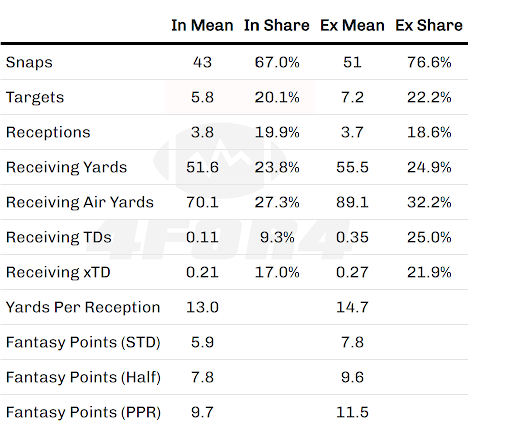
The Bronco’s problems didn’t simply start at quarterback, though; the issues stemmed from the top down, evidenced by the need to hire and fire multiple coaches, from Vic Fangio to Nathaniel Hackett, before finally settling on Sean Payton. Payton appears to have stabilized the organization, and the addition of Russell Wilson was certainly a step in the right direction regarding quality quarterback play. Yet, Jerry Jeudy remains fairly ineffective and doesn’t look to be on track to develop into a go-to number-one receiver.
Sometimes, a player doesn’t live up to their profile or potential, and there’s nothing we can do about it. As I laid it out, you could see the signs everywhere lit up like neon lights. There were many factors contributing to Jeudy’s lack of development and success, but it’s important to recognize when this happens earlier rather than later and adjust your values appropriately.
PRESEASON TAKE: Tank Dell is an elite route runner, but his size will limit him.
WHAT WENT WRONG: Believing size still matters.
BMI Bros will hate this one, but size matters less and less in the NFL with each passing year. To be clear, size still matters (to an extent) unless you possess elite traits or skill sets.
We all remember the community fading Heisman winner DeVonta Smith due to his lack of size and low BMI. How did that work out? We ignored Smith’s elite route-running ability because he was 170 pounds entering the league. But we’ve seen smaller players like Steve Smith Sr. succeed before DeVonta, so why are we so gun-shy to pull the trigger on players like Tank Dell or Jordan Addison, even though they are elite route runners?
We don’t want to be wrong or look “stupid” because we believe in a player many didn’t and said wouldn’t succeed because of their size, which in the past was more common given smaller players received much less opportunity in the NFL. That’s changed in our current landscape; teams are much more willing to spend draft capital on smaller players and provide them opportunities to succeed.
I fell into the “group think” that Dell was too small, and my evaluation that his route running would allow him to succeed at the next level was gratuitous and potentially outright wrong. Adjust to the landscape, trust yourself, and trust your process.
PRESEASON TAKE: Fading Rookie Tight Ends
WHAT WENT WRONG: Identifying positional transition periods but not acting on them.
I recorded a video this offseason discussing positional transition periods and the dynasty landscape. You can find the video here. In summary, positional transition periods are windows in which the old guard in a position is aging out, and younger prospects are entering the league trying to fill the void left behind. We’ve witnessed this with quarterbacks recently, with the likes of Tom Brady and Drew Brees retiring and Joe Burrow, Josh Allen, Jalen Hurts, and Patrick Mahomes taking the torch. We are currently in the thick of it with running backs, given how fragile the top five dynasty running backs are. Christian McCaffrey and Saquon Barkley could fall out of the top five as soon as February when the season officially ends. The goal is to be able to identify these transition periods early on and get ahead of the market. One example was trading Travis Etienne for Jahmyr Gibbs before the 2023 season kicked off. I realized there would be a value fluctuation in which Gibbs would overtake Etienne in value and production (especially in the long term) and get ahead of it. Just weeks later, Gibbs moved ahead of Etienne in dynasty ranks everywhere. While I took my advice in this example, I also whiffed big time on the tight end position.
I identified the tight end transition period in the video linked above, but I didn’t act upon it and prioritize the position in rookie drafts. It was and is fairly obvious the tight-end position is top-heavy and fragile in its own right. Travis Kelce and George Kittle are 30+ years old, and while Mark Andrews is under 30, he’s no spring chicken at 28. It’s not hard to conclude there could be a good deal of changes at the top of the tight-end position over the next few years, but I certainly didn’t expect such an influx of talent in just one year. 2023 has given us Dalton Kincaid, Sam LaPorta, and even Michael Mayer is beginning to break out late in the year. Sadly, I have very few shares of any of the rookie tight ends. I was stuck in the past where tight ends didn’t perform their rookie seasons and took three years to break out. I could just buy them on the dip later, right? Maybe not…what we are seeing is tight ends coming into the league much more NFL-ready and teams willing to utilize them early and often. Similar to the shift in acceptance of smaller athletes, the NFL has become more tolerant of playing rookie tight ends early on and accelerating their development. LaPorta is currently TE3 overall, and we also have two other rookie tight ends with the top 12 (Kincaid and Ferguson).
Again, this was a lesson in adjusting to the new landscape of rookie tight end involvement and trusting yourself and your process.
It’s easy to move on and forget our mistakes, but I’d challenge everyone to reflect on some things they got wrong and self-reflect on what they could’ve done better; it can be very rewarding.
Thank you for reading. If you have any thoughts or questions and would like to discuss them, you can reach out to me on Twitter @WillieBeamanDFF.

