
Saquon Barkley (RB-NYG), as we all know, tore his anterior cruciate ligament (ACL) and meniscus in his right knee in Week 2 (September 20th) of the 2020 NFL season. It was a devastating injury for the consensus top-five fantasy player, an injury that would land him on the IR for the remainder of the season.
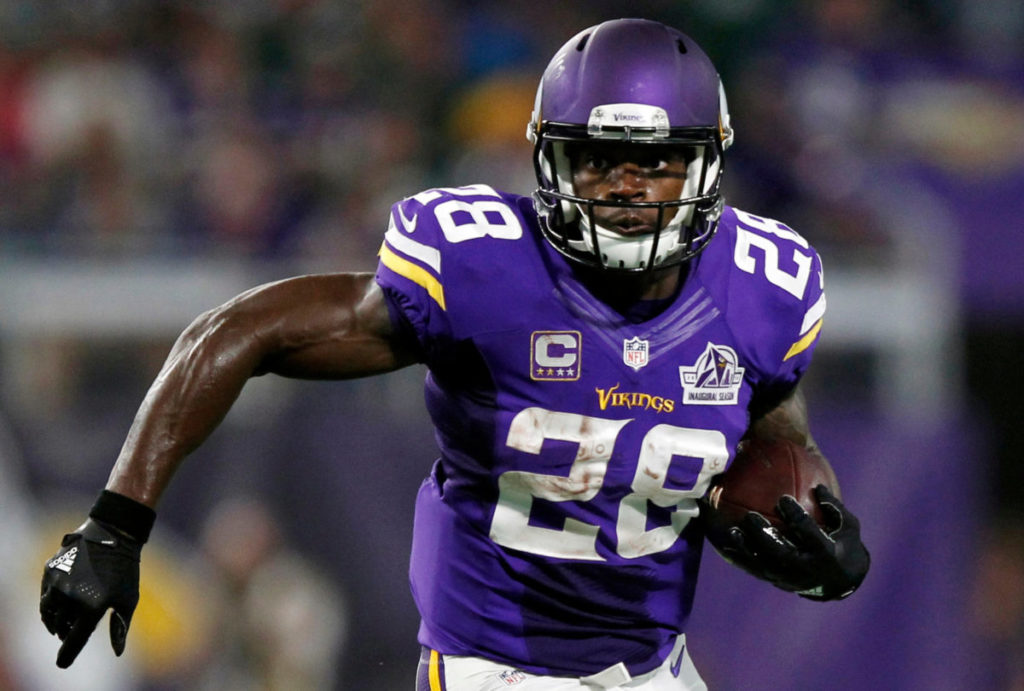
However, most assumed that he would be back to 100% by the start of the 2021 season and this assumption was reflected in his fourth overall fantasy ranking in half-point PPR. An assumption, that I like to call the Adrian Peterson effect or “The AP Effect” for short.

The AP Effect
So if you remember way back to 2011, AP tore his ACL, MCL, and meniscus in his left knee Week 16 (December 24th). He then had ACL repair surgery six days later (December 30th) before starting an extensive rehab program to get ready for the 2012 season. No one assumed that he would be back to 100% by the start of the season and his consensus rank reflected this as one of the top players in the NFL was ranked as the RB10 and the 24th overall player.
In hindsight, this ranking was an absolute steal as AP not only was ready for week one (September 9th) of the 2012 season, but he crushed it finishing as the RB one with 20.5 ppg in half-point PPR. He was able to return to an elite level in a mere 252 days or 8.5 months, forever creating the expectation that any running back who tore their ACL earlier than Week 16 should also be ready to go by week one of the following season. Hence “The AP Effect”.
What Does the Research Say?
Before we break down the research, I want to put out a disclaimer that at the end of the day all injuries are different as are all people. Even if it was possible to give the same injury (which it isn’t) to two similar athletes playing the same position, their recovery likely is going to show variance in their return to play. However, we do have years of athletes playing in the NFL and suffering similar injuries so we can start to look at the data to give us the best idea of when most athletes return to play.
Return to play following an ACL repair is very positional, as the demands on the stability of the knee are so different between positions so I will only be looking at studies with running backs and wide receivers. A 2021 study, looked at return to play in NFL running backs and wide receivers between the years 2009 and 2016 following an ACL repair. This group consisted of 72 players. What researchers found was that of the 72 players, only 61.8% ever returned to play an NFL snap.
What was the most interesting, was that of the 61.8% of players who returned to the NFL, the mean or average return to play was 13.6 months. 13.6 months…a casual 5.1 months later than when Adrian Peterson returned to play from injury. But like I mentioned, all people and all injuries are different, Peterson is an outlier.
All Injuries Aren’t Created Equal
When Saquon Barkley tore his ACL and meniscus, what is often forgotten is that he also had a grade 2 sprain of his medial collateral ligament (MCL). Which is better, as he didn’t tear this ligament as AP did. However, because his MCL didn’t need to be surgically repaired it needed to have time to heal and decrease swelling before his ACL repair surgery.
What that meant, was that he didn’t have his ACL surgery until October 30th, 40 days after his initial injury. This puts the beginning of his healing time at almost week eight, not week two as most people will reference. This new timeline gives him 318 days or around 10.5 months to fully recover.
Looking back at the previous study, this would still put him 3.1 months ahead of the league average for return to play. If we break down this article further, we find that of the 72 players, only three wide receivers and four running backs returned to play before the 10.5-month mark. An uninspiring 9.72%.
What Does This Mean For Barkley?
This is fantasy football, so let’s break down the implications for Barkley in this upcoming season. We all know that he is an electric athlete and one of the best running backs in the NFL when he is healthy. However, the reports are already stating that he likely will be eased back into his normal bell-cow role and be on a pitch count to start the year. The good news is that Barkley fits the parameters to make a full recovery to his previous level of function:
Age and draft capital. He is 24 years old which tends to be the cut-off age for running backs returning to form and also has high draft capital being selected number two overall by the Giants. This means the team will likely have much more patience for his recovery than a borderline roster player. Think Lamar Miller for an age example of a player never returning to form or play following his ACL tear before the 2019 season. Miller was a former Pro-Bowler but was 28 at the time of his ACL tear.
Conclusion
Right now, as mentioned, Barkley is the fourth-ranked player in consensus rankings. His ceiling is as high as the overall number one player in fantasy football, but given the time frames for normal return, his current cost, and the current coach speak regarding his “pitch count” I have him ranked as RB6 in half-point PPR redraft leagues.
This isn’t a huge drop in value but it likely means that I won’t be getting many shares of Barkley this season. He is the ultimate risk-reward pick in the first round but I continue to stick with the strategy of minimizing risk in the first round of the draft. Especially since the players around him have similar upside on projected better offenses.
Long term, I view Barkley as a dynasty buy if his value takes a dip due to the recent coach speak regarding the 2021 season as he still fits all the parameters of returning to his previous form. I just can’t safely project when that return to form will occur this season which is why I will be avoiding Barkley at his current cost in 2021. It feels like his fourth overall rank is a product of “The AP Effect” and doesn’t account for his current risks.
-Zach Pavlichek, PT, DPT @Zachpav42
Thanks for reading! I’m hoping to continue to help merge the medical and fantasy football worlds to help my readers to make the most informed decisions. If you are looking for more injury updates, information, or have any injury/fantasy-related questions feel free to follow me on Twitter @Zachpav42. Cheers!
References:
Carey, JL, Huffman, GR, Parekh, SG, Sennett, BJ. Outcomes of anterior cruciate ligament injuries to running backs and wide receivers in the National Football League. Am J Sports Med. 2006;34(12):1911–1917.
Manoharan A, Barton D, Khwaja A, Latt LD. Return to Play Rates in NFL Wide Receivers and Running Backs After ACL Reconstruction: An Updated Analysis. Orthopaedic Journal of Sports Medicine. January 2021. doi:10.1177/2325967120974743

