
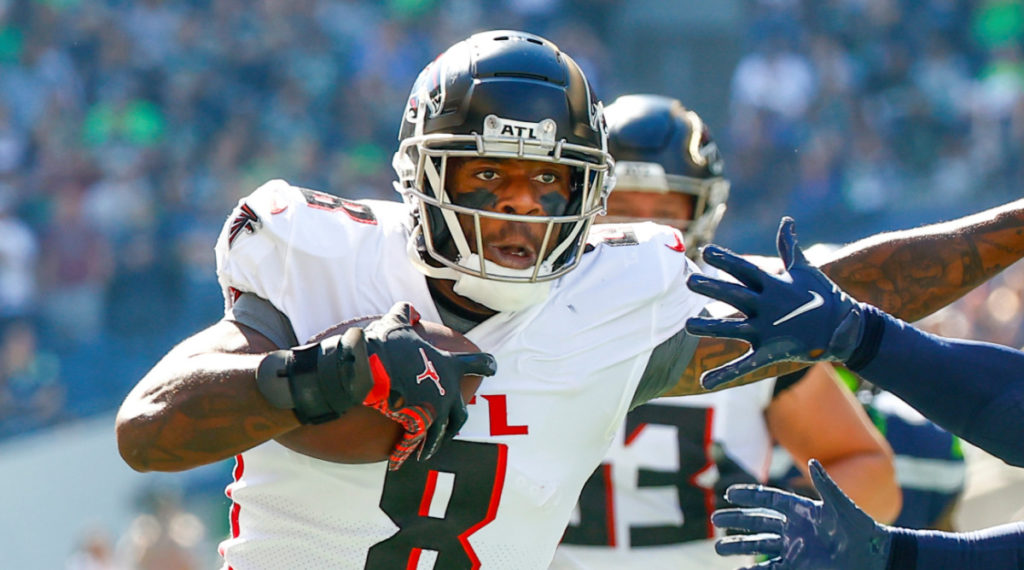
A unicorn without its horn is still a very special horse. Its defining characteristic is lost, but it’s easy to see that the magic is still there. When I think of magic (and more importantly, unicorns), I don’t imagine white manes, rainbows, or holographic elementary school backpacks. I think of Kyle Pitts. His “magic” comes in the form of ridiculous workout metrics, delectable college production, and tantalizing size. His “horn” is his TE designation. Come with me on a different type of fantasy journey as we explore the fate of Kyle Pitts’ dynasty value if he were to lose his TE designation.
Firstly, I find it important to take the time to outline the argument that Kyle Pitts is, in fact, a WR. The argument is rooted in the idea that since Kyle Pitts often lines up out wide or in the slot rather than as an inline blocker he should not be considered a TE. Let’s look at the numbers:
Snap Percentages by Position (per PFF)
- Inline TE: 27%
- Slot: 43%
- Wide: 30%
As noted above, Atlanta primarily utilizes Pitts as a big slot receiver in their offense. As expected, Pitts ran a route 64% of the time he was on the field. This percentage is greater than receivers like Mike Evans (63%) and D.K. Metcalf (60%), but lower than Davante Adams who ran a route on 69% of his snaps. This percentage is skewed towards teams with high passing volume, but the statistic nevertheless illustrates Pitt’s insane passing game usage that has critics theorizing a change in his position designation.
Of course, all of these factors beg the question: How realistic is a position change for someone like Pitts? Tight ends masquerading as receivers are not new to the NFL; Jimmy Graham and Mike Gesicki have produced in a similar fashion to Kyle Pitts, and both have lobbied – unsuccessfully – for position changes. This is likely due to the fact that top-flight tight ends do not command comparable monetary compensation as their WR counterparts. All of this is to say, if history repeats itself, Kyle Pitts will remain a TE.
However, for the sake of this article, we will operate under the assumption that Pitts DOES lose the coveted TE designation and becomes just another WR. When you look at the numbers from his rookie season you might be surprised.
Kyle Pitts’ Rookie Statistics: 1,026 Yards, 68 Receptions, 110 Targets, 1 TD, 15.09 YPC (176.6 Fantasy Points in PPR)
Pitts’ historic season was good enough for a juicy TE6 finish. However, when comparing Pitts’ production to last year’s WRs he slots in as WR35 between Brandon Aiyuk (170.6) and Marvin Jones (180.2). If we look at Pitts’ PPG of 10.4 he drops down to WR49 between rather pedestrian WRs DeVante Parker and Cedrick Wilson. But what if we compare him to some other WRs from his class? Again, the results might surprise you.
| Yards | Receptions | Targets | TDs | YPC | Fantasy Points (PPR) | |
|---|---|---|---|---|---|---|
| Ja’Marr Chase | 1,455 | 81 | 128 | 13 | 17.96 | 304.6 |
| Jaylen Waddle | 1,015 | 104 | 140 | 6 | 9.76 | 245.8 |
| Amon-Ra St. Brown | 912 | 90 | 112 | 5 | 10.13 | 227.3 |
| DeVonta Smith | 916 | 64 | 103 | 5 | 14.3 | 185.6 |
| Elijah Moore | 538 | 43 | 77 | 5 | 12.51 | 138.2 |
Pitts’ production would slot him in as the WR5 in his class. Pitts, however, compiled his production as a 21-year-old on the fourth-worst offense in the league. Pitts demonstrated impressive downfield usage throughout his rookie season as evidenced by his 10.1 ADOT which was higher than St. Brown (6.8) and Waddle (6.3). Additionally, Pitts’ 1,110 Air Yards were second to only Mark Andrews amongst TEs and greater than all rookies except for DeVonta Smith and Ja’Marr Chase. To make a rough assessment of how his value would be affected if a designation change were made I thought it would be valuable to find a WR with comparable rookie-year production. For this study, I decided to choose Tee Higgins.
Tee Higgins’ Rookie Statistics: 908 Yards, 67 Receptions, 108 Targets, 6 TDs, 13.55 YPC (194.6 Fantasy Points in PPR)
Higgins’ rookie production is fairly similar to Pitts’ rookie production except for the number of receiving TDs. Both players have exceptional size and essentially acted as their teams’ primary targets during the majority of their rookie years. Additionally, both players had a Round One WR added in the draft before their sophomore seasons. To approximate Pitts and Higgins’ peak values and values before the start of the 2022 NFL season I utilized community-derived rankings from the website KeepTradeCut.

Despite similarities in their production Pitts edged out Higgins in Peak Value, Rookie Value, and Preseason Value. In my opinion, this is largely a product of Pitts’ TE designation and promises of generational production. Higgins not only demonstrated that he is capable of producing at an elite level but additionally exhibited identical levels of consistency to Pitts with 10.4 PPG in PPR formats. Higgins is typically ranked as a top-10 WR asset. While I don’t necessarily believe WR Pitts should be ranked equally as highly, Higgins’ ranking provides a rough framework for where to begin.
Based on looking at comparable profiles I believe Pitts slots in as the dynasty WR20 in my rankings. That would place Pitts around similarly valued WRs like Rashod Bateman and teammate Drake London, but below receivers with more proven track records like Michael Pittman, D.K. Metcalf, and Diontae Johnson. The difference in value ends up being significantly less than I expected. Kyle Pitts is a special asset not only because of his TE designation. He’s special because he produced at a borderline historic level for any pass catcher his age. The TE designation is just a bonus that allows you to slot in another high-end asset into your lineup week after week.
I would be remiss not to address Kyle Pitts’ struggling start to the 2022 NFL season. He posted back-to-back weeks of two catches for 19 yards before bouncing back with a respectable five-reception 87-yard showing. Since then he has continued to disappoint and has dealt with a hamstring injury. These results are far from what we expected from a player who was routinely selected in the first round of start-ups throughout the summer. With this being said, this stretch of poor performances WILL be your last opportunity to grab a piece of this generational pass catcher at a reasonable price.
Pitts will retain his TE designation and will continue to provide league-winning upside that doesn’t come around very often. If you have the draft capital I would highly recommend sending one (or maybe two) of those coveted 2023 first-round picks with the hopes that you can add a little “magic” to your dynasty roster at a hefty discount.
Oh, hey. I didn’t see you there. Thanks for reading. If you found this content interesting, actionable, or straight-up incorrect, throw me a follow @WaiverWolf (Twitter, Instagram, & TikTok) or meet me at a local Philly bar so we can hash it out.

